
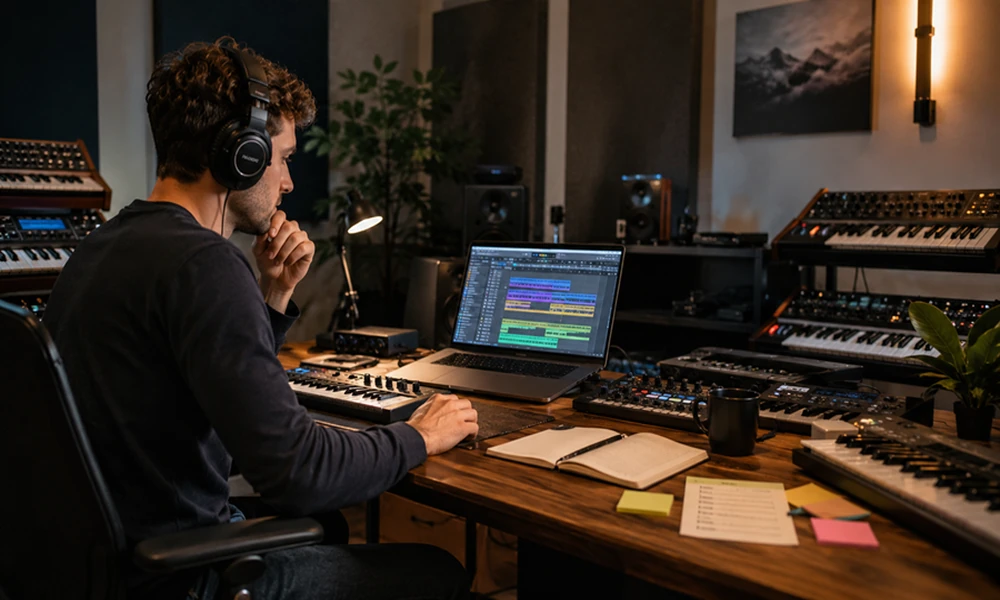
Opening a folder full of unfinished tracks can be frustrating. The ideas may be good: a strong bass line, an interesting drum groove, or a synth hook worth developing. Yet somewhere between the first loop and the finished master, progress stops.
Finishing electronic music is not simply a matter of finding more inspiration. Often, the problem is workflow. Producers can spend too much time perfecting individual sounds before deciding where the track is going, or start mixing before the arrangement is strong enough to support it.
A more deliberate production process can make finishing music easier and expose the skills that deserve the most attention.
Turn the Loop Into a Road Map
An eight- or sixteen-bar loop is useful for discovering an idea, but it does not yet define a complete track.
Once the core groove works, move fairly quickly into arrangement. Instead of polishing every detail, create a rough beginning, middle, and end. Duplicate sections where necessary and establish approximate locations for intros, builds, drops, breakdowns, verses, choruses, or other sections appropriate to the style.
The objective is not to produce a perfect arrangement immediately. It is to answer a more important question: does the musical idea have enough variety and development to remain interesting?
Listening to the entire rough arrangement also makes weaknesses easier to identify. A bass sound that feels exciting during a four-bar loop may become tiring after two minutes. A dramatic lead may work better when reserved for one section instead of appearing throughout the track.
Arrangement provides context, and context makes later production decisions easier.
Separate Creative Decisions From Technical Decisions
One reason sessions become difficult to finish is that producers constantly switch between creative and technical tasks.
Imagine writing a chord progression, stopping to adjust a compressor, returning to the melody, browsing kick drums, changing the reverb, and then rewriting the chords again. Each action may be reasonable, but the constant switching can prevent the track from developing.
Try dividing production into broader stages.
During the writing and arrangement stage, concentrate on musical ideas, energy, contrast, and structure. During sound-design sessions, focus on timbre, synthesis, sampling, and texture. Save detailed balancing, EQ, dynamics, and automation for a later stage when the arrangement is relatively stable.
There will always be overlap. A sound may need processing before it inspires the right performance, for example. The goal is simply to avoid treating every decision as equally urgent.
When you know what kind of problem you are solving, you are less likely to spend thirty minutes adjusting a plugin that was not causing the problem in the first place.
Build Skills Around Your Bottlenecks, Not Just Your Tools
Buying another synthesizer or downloading another sample collection can feel productive, but more options do not automatically solve production problems.
Instead, look at the point where your tracks repeatedly become difficult.
If your loops sound good but full tracks feel repetitive, arrangement and track-building skills may deserve attention. If you hear sounds in your head but cannot create them, synthesis and sound design may be the bottleneck. If productions lose clarity when vocals and multiple instruments enter, recording, processing, and mixing skills may need more deliberate practice.
This is also where structured learning can make sense. Producers who want to develop several connected skills rather than troubleshoot them separately may benefit from electronic music production training that covers areas such as track building, sound design, beat-making, vocal production, processing, and mixing within a broader production workflow.
The important point is to identify the skill behind the obstacle. Improving that skill is usually more valuable than adding another piece of software.
Make Sound Selection Part of the Arrangement
Mixing problems sometimes begin much earlier than the mix.
If several sounds occupy similar frequency ranges, have similar rhythms, or compete for the listener’s attention, balancing them later becomes difficult. Producers may reach for increasingly aggressive EQ or compression when the simpler answer is to change the arrangement or select a different sound.
Ask what role each element serves.
Does the percussion add movement that the main drums lack? Does a pad provide atmosphere without masking the lead? Does the bass complement the kick rhythmically as well as sonically? Does every melodic layer contribute something distinct?
Removing unnecessary elements can be just as important as adding new ones.
This is particularly useful when a project has grown complicated. Temporarily mute tracks one at a time. If removing something makes the production clearer without reducing its musical impact, that part may not be necessary.
A cleaner arrangement gives the mix more room to work.
Define What “Finished” Means Before the Final Session
Perfection is difficult to measure, which makes it a poor finishing criterion.
A practical alternative is to create a completion checklist. Before considering a track finished, listen for obvious arrangement gaps, distracting transitions, poorly balanced elements, unwanted distortion, inconsistent vocal levels, excessive low-frequency buildup, and automation that does not behave as intended.
Then export the track and listen away from the production session.
Changing the listening environment can make it easier to notice issues that disappear after hours of repeatedly hearing the same project. Make notes instead of immediately reopening the session. When you return, address the specific problems on the list rather than redesigning the entire production.
Most importantly, establish a stopping point. Every track could theoretically be revised forever. Completing music teaches skills that endlessly adjusting one project cannot: decision-making, perspective, workflow, and the ability to carry an idea all the way to its final form.
Conclusion
Finishing more electronic music does not require rushing the creative process. It requires recognizing which decisions belong at each stage and understanding when a technical problem is actually an arrangement, sound-design, or skill-development problem.
Build the structure before obsessing over details. Separate creative work from technical refinement when possible. Identify recurring bottlenecks, choose sounds that cooperate with the arrangement, and define a clear standard for completion.
A finished track provides something an unfinished loop never can: a complete view of your strengths, weaknesses, and progress as a producer.